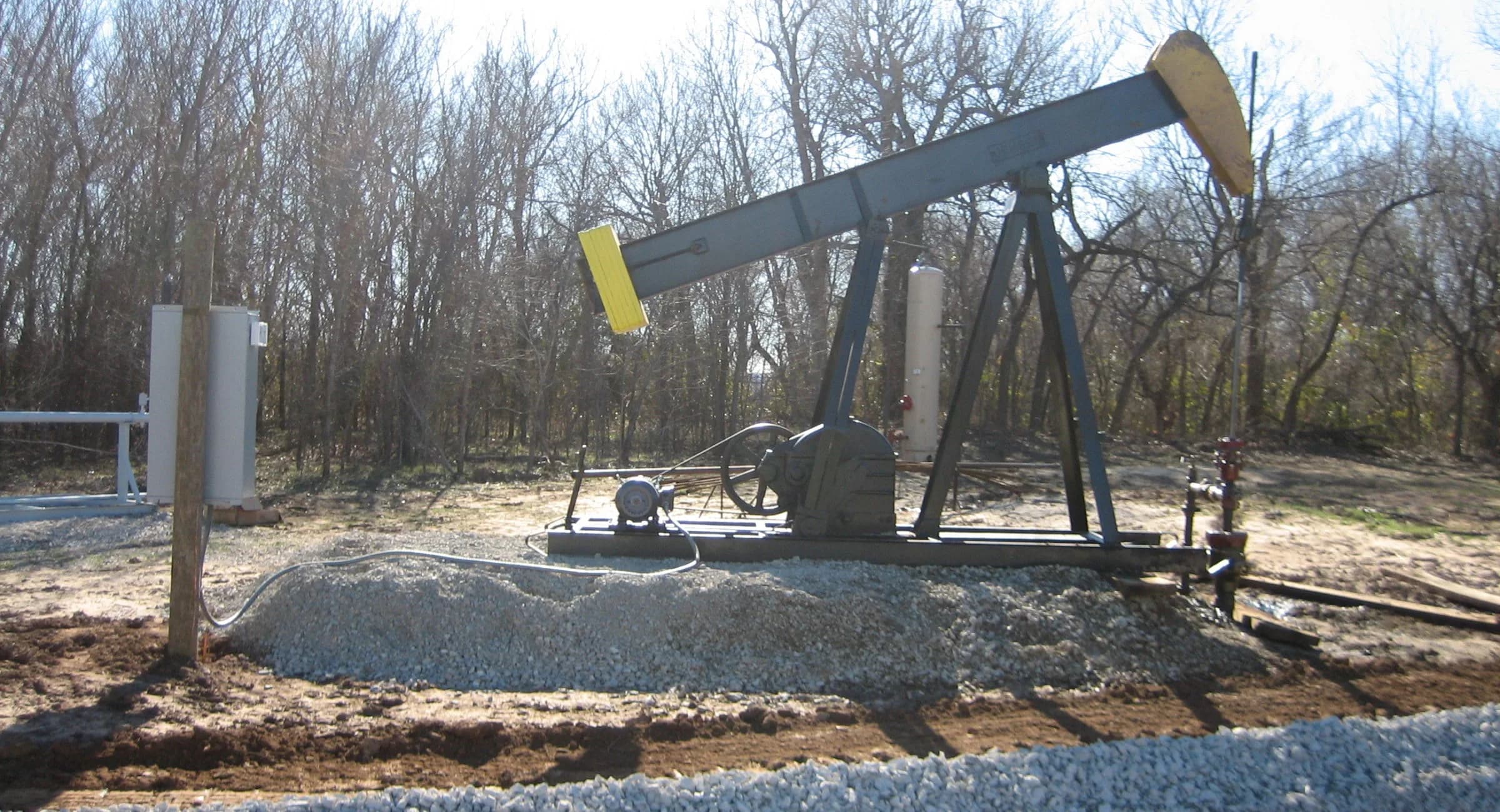
Drilling
11- AFE (Authorization for Expenditure)
- A budget document prepared by the operator itemizing estimated costs for a proposed well or workover, submitted to working interest owners for approval prior to the expenditure.
- Casing
- Steel pipe that is cemented into the wellbore to stabilize the hole, isolate fluid-bearing formations, and protect fresh water zones.
- Completion
- The process of making a well ready for production, including perforating the production casing, hydraulic fracturing or other stimulation, and installing wellhead equipment.
- Day Rate
- The daily charge for a drilling rig and its crew, typically the largest single line item in a drilling AFE.
- Directional Drilling
- Intentionally deviating a wellbore from vertical to reach a subsurface target at a lateral distance from the surface location.
- Dry Hole
- A well that encounters no commercially viable hydrocarbons. Working interest owners lose their entire drilling investment in a dry hole.
- Hydraulic Fracturing (Fracking)
- A completion technique in which fluid is pumped at high pressure to fracture the rock formation, and sand (proppant) is injected to hold the fractures open and increase flow to the wellbore.
- Mud (Drilling Mud)
- A fluid circulated down the drill string and back up the annulus to cool the drill bit, carry cuttings to the surface, and maintain wellbore pressure control.
- Spud Date
- The date on which drilling of a well officially begins, marked by first penetration of the earth by the drill bit.
- Total Depth (TD)
- The deepest point reached by the drill bit in a wellbore.
- Workover
- Remedial operations on a producing well to restore or increase production, such as re-perforating, fracturing, or replacing downhole equipment.
Production
10- Barrel (BBL)
- The standard unit of measurement for oil volume, equal to 42 U.S. gallons.
- BOE (Barrel of Oil Equivalent)
- A unit that converts gas volumes to an oil-equivalent basis for reporting; one BOE equals approximately 6 Mcf of natural gas.
- Decline Curve
- A mathematical model that forecasts future production volumes based on the historical production trend of a well or field.
- EUR (Estimated Ultimate Recovery)
- The total volume of hydrocarbons expected to be produced from a well or reservoir over its economic life.
- Flow Rate
- The volume of oil or gas produced per unit of time, typically expressed in barrels per day (BOPD) for oil or thousand cubic feet per day (Mcfd) for gas.
- JIB (Joint Interest Billing)
- The monthly expense statement from the operator to working interest owners, itemizing operating costs charged to each owner's working interest.
- Mcf
- One thousand cubic feet of natural gas, the standard unit for small gas volumes. MMcf = one million cubic feet.
- Produced Water
- Water that is brought to the surface along with oil and gas production; often highly saline and must be disposed of by injection into permitted disposal wells.
- Separator
- A vessel at the wellsite that separates the produced fluid stream into its oil, gas, and water components.
- Wellhead
- The assembly of equipment at the surface of a well that supports and seals the casing and provides access for production equipment.
Legal & Land
10- Division Order
- A document that authorizes the purchaser of production to distribute revenue to each interest owner according to their ownership decimal, as established in the title opinion.
- Farmout Agreement
- An agreement in which one party (the farmor) assigns a working interest or part of a working interest to another party (the farmee) in exchange for the farmee drilling or developing the acreage.
- JOA (Joint Operating Agreement)
- The contract between working interest owners that governs how a well or lease will be operated, including the designation of the operator, cost-sharing obligations, and non-consent provisions.
- Mineral Rights
- The ownership rights to subsurface oil, gas, and other minerals beneath a tract of land, which may be severed from surface ownership.
- Non-Consent
- A provision in a JOA allowing a working interest owner to decline participation in a proposed well. Non-consenting owners typically forfeit a penalty interest in revenues until the consenting owners recover their costs plus a penalty multiple.
- Oil and Gas Lease
- A contract between the mineral owner (lessor) and the operator (lessee) granting the right to explore for and produce oil and gas in exchange for a royalty payment and a bonus.
- ORRI (Overriding Royalty Interest)
- A non-cost-bearing interest in production that is carved out of the working interest, often retained by a landman or geologist as compensation for putting a deal together.
- Royalty Interest
- A non-cost-bearing ownership interest in production, typically reserved by the mineral owner in the oil and gas lease, expressed as a fraction of gross production.
- Title Opinion
- An attorney's written analysis of the chain of title to oil and gas rights in a specific tract, establishing who owns what percentage of the mineral rights and any encumbrances.
- Working Interest (WI)
- An ownership interest in the operating rights under an oil and gas lease that bears a proportionate share of drilling, completion, and operating costs.
Financial
8- Cash Call
- A request by the operator to working interest owners to fund their proportionate share of upcoming expenditures, typically due within 15–30 days.
- Cost Depletion
- A method of deducting the capital cost of oil and gas properties by allocating the investment over the estimated total recoverable reserves.
- IDC (Intangible Drilling Cost)
- The non-salvageable costs of drilling a well — labor, fuel, chemicals, drilling mud — that may be fully deducted in the year incurred by qualifying working interest owners.
- NRI (Net Revenue Interest)
- The fraction of gross production revenue received by a working interest owner after all royalties and overriding royalties are paid out.
- Payout
- The point at which cumulative revenues from a well equal cumulative costs; after payout, some farmout or carried interest arrangements convert to a different ownership structure.
- Percentage Depletion
- A statutory deduction allowing independent producers to deduct a fixed percentage (currently 15%) of gross income from qualifying oil and gas properties each year.
- PV10
- The present value of estimated future net revenues from proved reserves, discounted at 10% per year, used as a standardized measure of oil and gas property value.
- Reserve Report
- A document prepared by a qualified petroleum engineer estimating the volumes of oil and gas recoverable from a property and their economic value under specified price and cost assumptions.
Regulatory
6- BLM (Bureau of Land Management)
- The federal agency that administers oil and gas leasing and permitting on federal onshore lands.
- Plug and Abandon (P&A)
- The process of permanently sealing a well at the end of its productive life using cement plugs and surface equipment removal, as required by state regulators.
- RRC (Railroad Commission of Texas)
- The primary state regulatory agency for the oil and gas industry in Texas, overseeing drilling permits, production rules, pipeline safety, and well plugging.
- Spacing Unit
- The area of land assigned to a single well for regulatory purposes, used to prevent waste and protect correlative rights of mineral owners.
- Statewide Rule (Texas)
- A regulation issued by the Texas Railroad Commission that applies uniformly across the state, covering topics such as casing requirements, flaring, and produced water disposal.
- UIC (Underground Injection Control)
- An EPA program that regulates the injection of fluids underground, including the disposal of produced water into Class II injection wells.